
A domain name looks like one of the smallest decisions involved in building a website.
It often becomes one of the longest-lasting.
You can replace your hosting company. You can redesign the website. You can change your theme, logo, plugins, colours, and even the type of content you publish.
Changing the domain later is possible too, but it is usually far more inconvenient.
Old links may need redirects. Email addresses may change. Visitors have to learn a new name. Printed material becomes outdated. Search engines need time to understand the move.
That is why spending an extra hour choosing a domain before registration can save a surprising amount of work later.
The goal is not to find the cleverest domain available.
It is to find a name that people can remember, type correctly, trust, and still associate with your website several years from now.
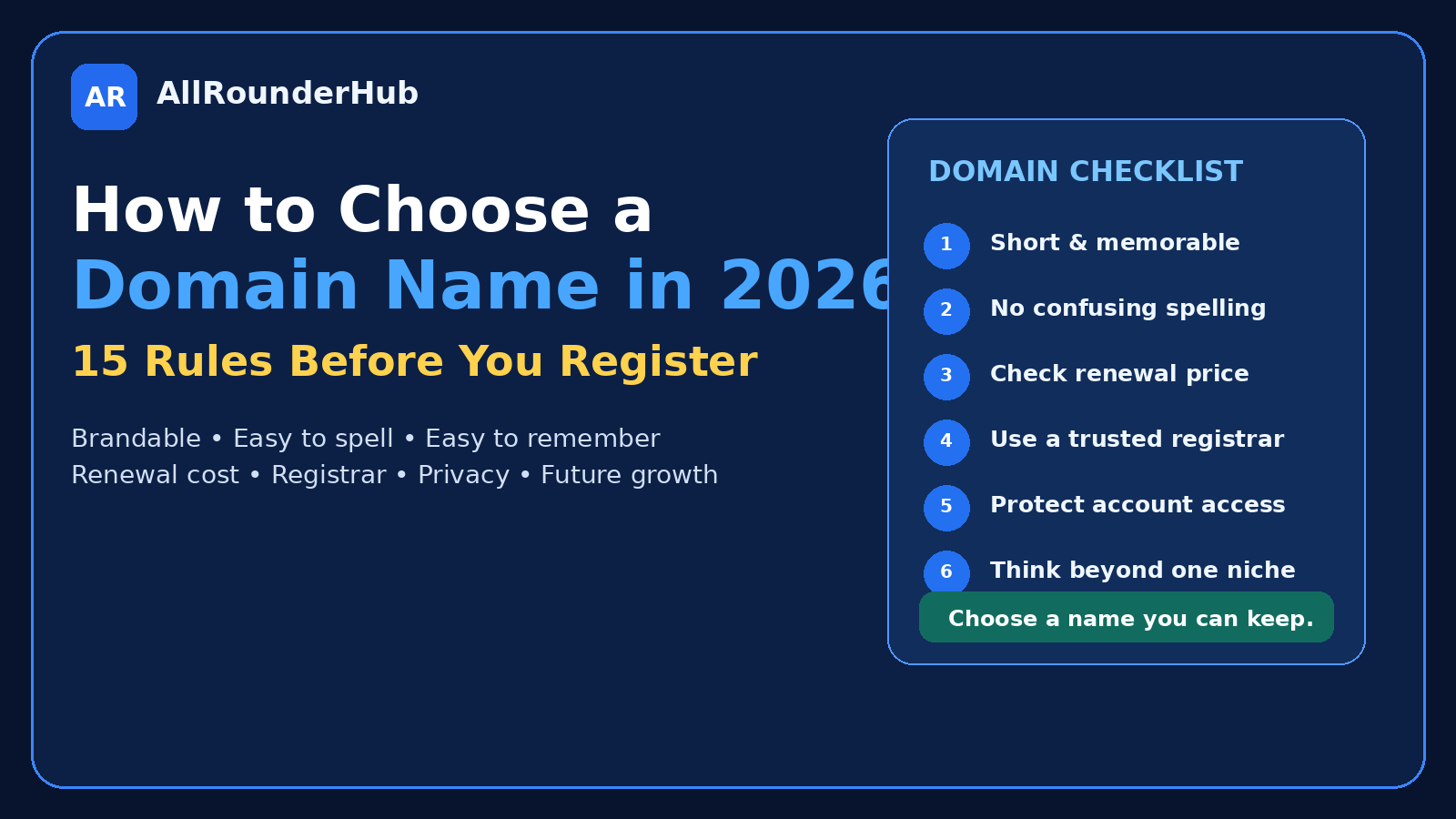
Here are 15 practical rules worth checking before you register one.
1. Choose the Brand Before Chasing Keywords
A few years ago, website owners often tried to squeeze an exact search phrase into the domain.
That can lead to names such as:
best-cheap-laptops-online-example.com
The problem is obvious.
It may describe one search query, but it does not sound like a brand anybody wants to remember.
A domain does not need to contain every keyword you hope to rank for.
Your articles, categories, headings, internal links and overall website content provide search engines with much more information about what the site covers.
A domain should first work as the name of the website.
Ask:
“Would I be comfortable telling someone this name over the phone?”
If the answer is yes, you are probably heading in a better direction.
2. Keep It Short Enough to Remember
Short domains have an obvious advantage: there is less to remember and less to type incorrectly.
That does not mean every good domain must contain five letters.
A slightly longer name that makes sense can be better than a short collection of random characters.
Compare:
brightdesk.com
with something like:
bdxqpro.com
The second may technically be shorter, but the first is easier to say, remember and recognize.
Do not chase character count at the expense of clarity.
Your real goal is memorability.
3. Say the Domain Out Loud
This simple test catches problems that are easy to miss while staring at a screen.
Say the domain aloud once.
Then imagine telling it to somebody who has never seen it written.
Would they know how to spell it?
Would you immediately have to explain:
“That’s with two S’s.”
“There is a hyphen between the words.”
“It’s number 4, not the word four.”
“The spelling is intentionally different.”
Every extra explanation increases the chance of losing a visitor.
The best domain names usually survive the spoken-word test without needing instructions.
4. Avoid Clever Misspellings Unless They Are Truly Part of the Brand
Deliberately misspelled words can sometimes become successful brands.
They can also create years of unnecessary confusion.
If the correct spelling of your business name sends people to somebody else’s website, you may end up constantly correcting customers.
Before using an unusual spelling, ask whether the branding benefit is genuinely worth that friction.
For a new publisher, blog, comparison site or small business, straightforward spelling is usually the safer option.
People should spend their attention on your content — not on remembering how creatively you spell your name.
5. Be Careful With Hyphens
A hyphen can make an otherwise unavailable domain possible.
That does not mean it is automatically a good choice.
Hyphens are easy to forget when people type a domain from memory, and they make spoken recommendations slightly more awkward.
Compare:
smartbuyer.com
with:
smart-buyer.com
If somebody only hears the name, which version are they likely to type first?
Sometimes a hyphenated domain is still perfectly usable, especially when the brand is already established.
For a new website, though, I would normally prefer a clean alternative without one.
6. Avoid Numbers That Can Be Misunderstood
Numbers create the same spoken problem.
If your domain contains 4, does the visitor type:
4
or
four?
If the number is an intentional part of an existing brand, that may not matter.
If you are creating a completely new brand, there is little reason to introduce ambiguity unnecessarily.
The easier your domain is to communicate, the better.
7. Think Beyond the First Topic You Plan to Publish
This mistake is particularly common with content and affiliate websites.
Imagine you start with articles about laptops and register a domain that effectively means:
“Only Laptop Reviews.”
Six months later, you want to cover software.
Then AI tools.
Then hosting.
Then mobile accessories.
The original domain suddenly feels restrictive.
This does not mean the name must be meaningless.
It means you should leave enough room for the business or publication to grow naturally.
Before registering, ask:
Would this name still make sense if my website became three times broader?
If the answer is no, consider a slightly more flexible brand.
8. Choose the Extension Based on Your Audience
.com remains one of the most familiar domain extensions internationally.
But it is not the only sensible choice.
A business focused strongly on India may reasonably consider .in.
Organizations may use .org.
Technology companies sometimes use industry-specific alternatives.
The right extension depends on the identity and audience of the project.
What I would avoid is choosing an unusual extension only because the matching .com is unavailable without considering how the complete address will look to visitors.
The extension is part of your brand too.
9. Check Who Already Uses Similar Names
Before becoming attached to a domain, search for the name.
Look beyond whether the exact domain is available.
Check whether there is already:
- a well-known company with the same name;
- a similar business operating in your market;
- a major app using the term;
- active social accounts under the same brand;
- obvious trademark conflicts.
Finding an available domain does not automatically mean the corresponding brand name is safe for every commercial use.
If the website is intended to become a serious business, trademark questions can deserve professional legal advice.
That is cheaper than building a brand for two years and discovering a major naming conflict later.
10. Check Social Handles Before Registering
Your domain and social-media usernames do not need to match perfectly.
It is still useful when they are reasonably consistent.
Before registering a new brand, search the main platforms you are likely to use.
If the domain is:
ExampleBrand.com
but every sensible version of @ExampleBrand is already occupied by unrelated businesses, you may want to reconsider.
You are not trying to own every username on the internet.
You are simply checking whether the brand will be easy to represent consistently.
11. Look at the Renewal Price, Not Only Registration Price
Domain promotions can make the first year extremely inexpensive.
The first year is only one year.
If you build a successful website, you may keep the domain for ten years or longer.
That makes the renewal price far more important than a temporary introductory discount.
Before registration, check:
- first-year price;
- normal renewal price;
- taxes;
- privacy charges if applicable;
- transfer pricing;
- redemption or restoration fees after expiry.
ICANN notes that domain registration terms, including fees, transfers and renewals, are governed through the agreement between the registrant and registrar. citeturn558541search8
Do not choose a registrar because one banner shows the cheapest first-year number.
Think about ownership over time.
12. Use a Reputable Registrar
The registrar is the company responsible for managing your domain registration.
ICANN explains that generic top-level domains can be registered through ICANN-accredited registrars or their resellers. citeturn558541search1
The cheapest registrar is not automatically the best choice.
Things worth checking include:
- account security;
- two-factor authentication;
- renewal controls;
- domain-lock features;
- transfer process;
- support;
- DNS management;
- pricing transparency.
Your domain is one of the most important assets connected to a website.
Saving a tiny amount each year is not worthwhile if the account is difficult to secure or manage.
13. Protect the Account, Not Just the Website
Website security often gets most of the attention.
Domain-account security can be even more important.
If someone gains control of your hosting account, that is serious.
If someone gains control of your domain, they may be able to point visitors somewhere else entirely.
Use:
- a strong unique password;
- two-factor authentication where available;
- an email account you will retain long-term;
- registrar/domain locks where appropriate;
- accurate contact information.
Do not share domain-account credentials casually with developers or contractors.
If somebody needs website access, give them the minimum access necessary for their work.
14. Turn On Renewal Protection — but Still Track the Date Yourself
Losing a domain because somebody forgot the renewal date is an avoidable problem.
Auto-renewal can reduce that risk.
But do not rely on automation alone.
Cards expire.
Payment methods change.
Emails land in spam.
Accounts get forgotten.
Record your important domain expiry dates somewhere you will actually see them.
For a business-critical domain, I would want both automatic renewal and a separate reminder.
That is a small amount of effort for an asset the entire website may depend on.
15. Ask One Final Question Before You Pay
Before registering, close the registrar website for a few minutes.
Then try to remember the domain without looking.
If you can remember it, spell it, say it naturally and still like it after stepping away from the checkout screen, that is a good sign.
Then ask:
Would I still be happy using this as my brand five years from now?
You cannot predict everything your website will become.
You can avoid choosing a name you already suspect you will outgrow.
Should You Buy the Domain and Hosting From the Same Company?
You can.
You do not have to.
Buying both from one provider can make setup and billing simpler, especially for beginners.
Keeping the domain with a dedicated registrar and hosting elsewhere can provide more separation and flexibility.
Neither approach is automatically correct.
The important thing is that you understand:
- where the domain is registered;
- where DNS is managed;
- where the website is hosted;
- who controls each account.
If you are still deciding on hosting, read How to Choose Web Hosting in 2026: 12 Things to Check Before You Pay before purchasing a long-term plan.
Should You Buy Several Versions of the Same Domain?
For a normal new website, there is usually no reason to register twenty variations of the name.
However, businesses sometimes protect important variants.
For example, a company operating mainly in India might own its primary .com along with the matching .in.
A brand with a commonly mistyped name might register an obvious typo and redirect it.
Do this when there is a practical reason.
Do not turn defensive domain registration into a collection hobby.
Every additional domain creates another renewal to manage.
What If the Domain You Want Is Already Taken?
Do not immediately add random numbers and hyphens.
Try changing the brand itself.
A small modifier can often produce a much cleaner result.
For example, instead of:
besttoolreviews247.com
you might find a more distinctive brand name that is easier to remember.
You can also consider an appropriate alternative extension if it makes sense for the audience.
If the domain belongs to an active company or established brand, move on.
Your time is usually better spent building a distinct identity than trying to imitate someone else’s.
Should You Buy an Expensive Premium Domain?
Sometimes.
But a premium domain is not automatically a better business.
A memorable short name can have real value, particularly for a funded company with a clear brand strategy.
For a new content website or small side project, spending a large part of the budget on the domain often makes less sense than investing in good hosting, useful content and the actual product or service.
Do not buy a premium domain because you believe the name itself will make the website successful.
It will not.
A great name helps.
The website still has to earn attention.
Domain Name vs Website Name: Do They Need to Match Exactly?
Not necessarily.
They should normally be close enough that visitors understand the connection.
For example, removing spaces is obviously unavoidable in a domain.
A longer legal business name may also use a shorter web brand.
Problems begin when the domain and visible website brand feel unrelated.
Consistency builds recognition.
The easier it is for someone to see your logo, hear your brand and remember your URL, the better.
Domain Checklist Before Registration
Before paying, check the name one last time:
- Is it easy to remember?
- Is it easy to spell?
- Can I say it without explaining it?
- Is it reasonably short?
- Have I avoided unnecessary hyphens?
- Have I avoided confusing numbers?
- Can the brand grow beyond one narrow topic?
- Does the extension fit my audience?
- Have I searched for similar businesses?
- Have I checked important social handles?
- Do I know the renewal price?
- Is the registrar reputable?
- Can I secure the account with strong authentication?
- Have I considered renewal protection?
- Would I still want this domain five years from now?
If the answer to several of these is no, do not rush.
There will always be another domain.
Rebranding a website later is much more annoying than spending another evening finding the right name now.
Final Thoughts
The best domain names often feel simple in hindsight.
They are easy to say.
Easy to spell.
Easy to remember.
They give the website room to grow and do not require a long explanation.
Do not choose a domain based only on whether it contains a keyword.
Do not let a first-year discount make the decision for you.
And do not register something simply because you have been searching for names for three hours and want the process to end.
Your domain may appear on every article, email, social profile, advertisement and business card you create.
Choose one you will be comfortable repeating thousands of times.
Then stop searching and start building.
Frequently Asked Questions
Is .com better than .in?
Neither is universally better. .com is widely recognized internationally, while .in can make sense for a project strongly focused on India. The right choice depends on the audience and brand.
Should my domain contain my main SEO keyword?
It does not have to. A brandable, memorable domain can be a better long-term choice than forcing an exact search phrase into the name.
Can I change my domain later?
Yes, but changing an established website’s domain involves additional work such as redirects, updating links and communicating the change to visitors. Choosing carefully at the beginning is easier.
Should I buy domain and hosting together?
You can, and doing so may simplify setup. You can also keep them with separate providers. What matters most is knowing which account controls the domain and keeping that account secure.
How long should a domain name be?
There is no perfect character count. Prefer the shortest name that remains clear, memorable and natural rather than shortening it until it becomes difficult to understand.
Is it worth buying a premium domain?
Only when the name has enough strategic value to justify the price. New websites should not assume an expensive domain will compensate for weak content, products or execution.
Sources & Verification
This guide was last checked on August 24, 2026 against official domain-registration resources. Domain availability, registration terms, renewal prices and registrar services can change, so verify the exact domain and registrar terms before purchase.
Editorial Note
Domain availability, registration prices, renewal charges, transfer rules and registrar features can change. Check the registrar’s current terms before purchasing.
Affiliate Disclosure
AllRounderHub may contain affiliate links. If you purchase a product or service through an eligible affiliate link, we may earn a commission at no additional cost to you. Affiliate relationships do not determine our editorial conclusions.
Continue learning: use the web hosting checklist, estimate costs with the website budget guide, and compare beginner WordPress hosting options.
2 thoughts on “How to Choose a Domain Name in 2026: 15 Rules Before You Register”
Comments are closed.