
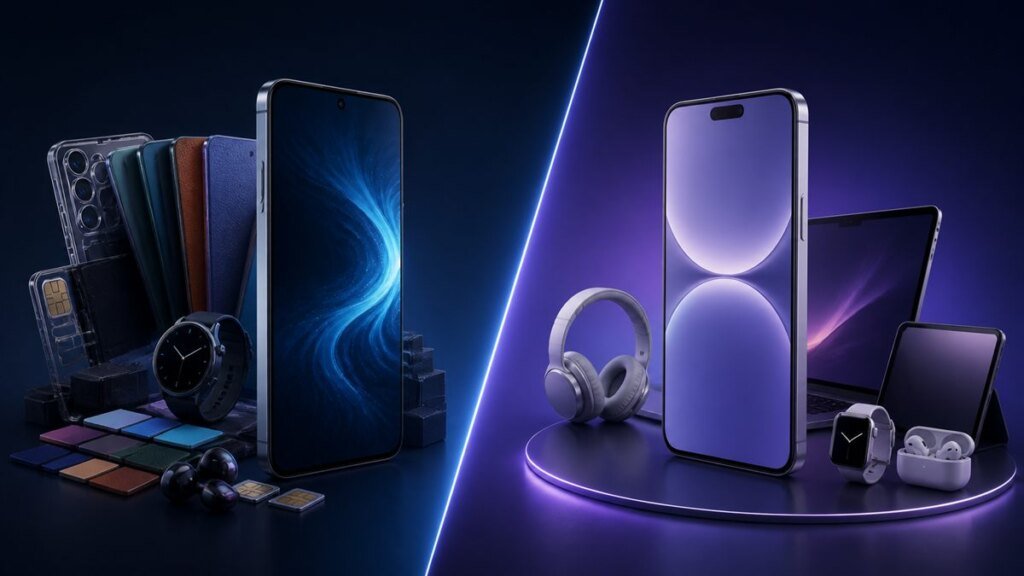
Android and iPhone are not single devices at the same price. Android runs across phones from many manufacturers, while iOS is available only on Apple’s iPhone range. A useful comparison therefore starts with your budget, required apps and existing devices—not a claim that one platform wins every category.
Quick verdict: Android is the stronger choice for device variety, customization and more price points. iPhone is the stronger choice for a consistent Apple-controlled experience and close integration with other Apple products. Security and camera quality depend on the exact model, settings and update status.
Android vs iPhone at a glance
| Priority | Better fit | Reason |
|---|---|---|
| Device and price choice | Android | Many manufacturers, form factors and price ranges. |
| Customization | Android | More launcher, default-app and interface variation. |
| Apple device integration | iPhone | Designed to work closely with Mac, Apple Watch, iPad and Apple services. |
| Consistent update source | iPhone | Apple controls both supported iPhone hardware and iOS distribution. |
| Flexible hardware designs | Android | Choice includes compact, foldable, gaming and stylus-focused phones. |
| Universal privacy winner | None | Both provide permissions and safety controls; actual privacy depends on apps, account settings and use. |
Price and hardware choice
Android’s biggest advantage is range. Buyers can choose devices from Google, Samsung and other manufacturers across budget, mid-range, flagship and foldable categories. Specifications and software policies vary, so compare the exact model rather than assuming all Android phones behave alike.
Apple sells a smaller iPhone lineup with consistent iOS integration. Older models remain available through resellers, but eligibility for the latest iOS and individual features depends on the model. Compare current Apple and authorized-reseller pricing in your country because trade-ins, carrier offers and taxes can change the effective cost.
Customization and everyday use
Android gives manufacturers freedom to tailor the interface and hardware. Users can choose launchers, widgets, keyboards, default apps and other interface options, although the exact choices vary by device and Android version.
iPhone provides customization through widgets, lock-screen controls, Focus modes and supported default-app settings, but Apple maintains a more uniform system. This consistency can reduce differences between models, while Android’s variety can either be a benefit or an extra learning step.
Apps and ecosystem
Most major services are available on both platforms. Check any specialist banking, accessibility, business, health or hardware-control app before switching. Purchased apps, subscriptions and in-app data may not transfer automatically between stores.
Android works especially well with Google services and a wide range of connected devices. iPhone integrates closely with Mac, iPad, Apple Watch, AirPods, iCloud, AirDrop and Continuity features. The better ecosystem is usually the one that already contains your computer, watch, cloud storage and family accounts.
Updates and device lifetime
Apple distributes iOS updates to supported iPhones, but Apple does not promise the same fixed support period for every model on its public comparison page. Check whether the exact iPhone appears on the current iOS compatibility list.
Android update commitments vary by manufacturer and model. Newer premium devices may receive long support periods, while low-cost or older phones may receive fewer major upgrades. Read the manufacturer’s written update policy for the exact model before buying, not only the Android version shown at launch.
Privacy and security
Android provides a privacy dashboard, centralized permission controls, camera and microphone indicators, one-time permissions, Google Play data-safety information and Play Protect. Manufacturer features and update timing can differ.
Apple provides app permissions, App Store privacy information, on-device processing for many features, tracking controls and security technologies integrated across hardware and software. Some Apple Intelligence requests may use Private Cloud Compute under Apple’s published privacy design.
Neither platform eliminates risk. Keep the operating system updated, use a screen lock and multi-factor authentication, review app permissions and avoid unofficial downloads. A supported mid-range phone with careful settings is safer than an unsupported flagship with old software.
Camera and performance
There is no platform-wide camera winner. Android includes many camera systems and processing styles; iPhone models also differ by sensor, lens and feature set. Compare the exact phones for low light, zoom, portrait, video, microphone quality and editing workflow.
Performance depends on the processor, RAM, thermal design, storage and software. Benchmark scores do not always predict battery life or app smoothness. Test the apps and games you actually use and review long-term update support.
Repair, storage and switching
Repair cost, spare-part availability and service networks vary by manufacturer and country. Some Android phones offer expandable storage, while iPhones use fixed internal storage. Cloud plans are separate ongoing costs on both platforms.
Both Google and Apple offer switching tools, but messages, authenticator apps, health data, locally stored media and paid purchases require careful migration. Keep the old phone until sign-ins, backups and two-factor authentication work on the new device.
Choose Android if you
- Want more choices in price, size, design or form factor.
- Prefer extensive interface and default-app customization.
- Need a feature such as a foldable screen, stylus or expandable storage on a particular model.
- Primarily use Google services or mixed-brand devices.
Choose iPhone if you
- Already use a Mac, iPad, Apple Watch or other Apple services.
- Prefer one company controlling the hardware and operating-system update.
- Want a more consistent interface across supported models.
- Have confirmed that the required model, storage and repair costs fit your budget.
Final recommendation
Choose the exact phone, not only the platform. Set a budget, list essential apps and accessories, compare the written update policy, and test camera, display, keyboard and accessibility features in person. Android wins on breadth of choice; iPhone wins on Apple ecosystem consistency. Your existing devices and support requirements should decide the purchase.
Official sources checked
- Android phones and device choice
- Android privacy controls
- Google: Check and update Android
- Apple: Compare iPhone models
- Apple privacy features
- Apple: iPhone update compatibility
Details verified 27 August 2026. Features and support periods vary by model, country and software version.